Where to Start With AI in Your Small Business: Write Down What You Already Know
My favorite thing about AI this year has nothing to do with AI. It’s that it rewards us for having the clear processes, SOPs, and documentation we should have had all along.
As a Fractional COO, I am often the one creating this documentation. And for years, it has been a fight to get clients to do this. “No on ever looks at the SOPs after their created.” “We just create the documents, and then they die in the cloud.” But not anymore!
Every business book out there tells us to write this stuff down. Document your processes. Write down who your customer is. Get it out of your head. Most of us nodded along and never did it, because our human team members could fill in the gaps. Plus it feels like an overwhelming amount work that can quickly become out of date. They could ask a question in Slack, watch us do it once, or just figure it out.
Our AI team members can’t do that. They need the documentation more than any person we’ve ever hired, and when it exists and stays updated, Claude works. Without it, Claude guesses, and the guesses sound confident enough that you don’t catch them until a client does. But, unlike someone we have hired, they will follow that documentation – every time.
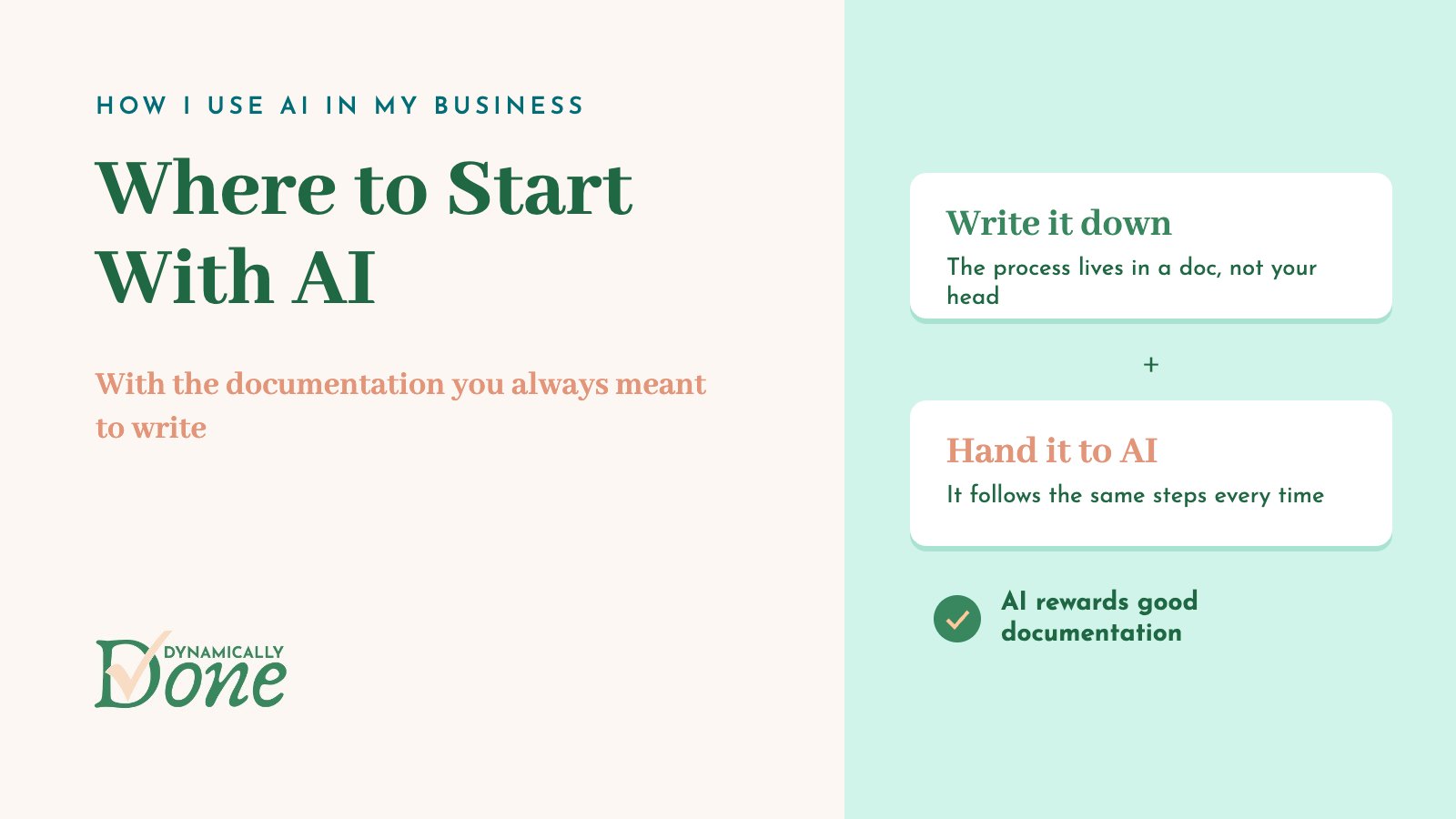
So when someone asks me where to start with AI, my answer is a little boring. Start with your documentation.
What Are Business Brain Documents?
Business brain documents are the handful of files that hold what you know about your own business, written down so anyone (or anything) can read them. They’re the context a new hire would need in their first week, and they’re what I hand Claude before it writes a single word for Dynamically Done.
Here’s the set I keep in my Claude project:
- About: what the business is, what it isn’t, and the mission behind it
- Ideal customer profiles: who I serve, in their own language, including the objections they bring up on sales calls
- Products and offerings: every offer, what’s included, the price, features/benefits of each
- Testimonials: compliments from clients (publicly shared and privately sent)
- Competitors: who else does this work and how I’m different
- Founder story: how I got here
- Opt-ins and lead magnets: what already exists, so I don’t build a second version of something I already have
- Career timeline: dates, roles, and which clients I can name publicly
None of these are fancy. A lot of mine started as voice notes (thank goodness for Wispr Flow) that Claude turned into a first draft for me to correct. What matters is that they exist in one place and they’re true.
Why AI Needs Documentation More Than Your Team Does
AI needs documentation more than your team does because it can’t ask the hallway question. A person on your team who’s unsure about pricing will message you. Claude will fill the gap with something plausible, and plausible is the dangerous part.
I think about it like handing someone the keys to your car. A friend who’s driven it before knows the brakes are touchy and the gas gauge lies. A valet doesn’t. You can either tell the valet every time, or tape a note to the dashboard.
How I Keep My Business Brain Docs From Going Stale
I keep them current with a scheduled task that runs on the 1st of every month. Claude reads every doc, compares them against what’s changed in my business over the past month, and sends me a list of proposed updates: the current text, the suggested replacement, and a one-line reason for each.
It changes nothing on its own. I approve what’s right, and only then does it edit the docs.
This matters more than it sounds. Offers get renamed, prices change, and a client who was fine to mention last spring might not be today. A stale doc is worse than no doc, because Claude will repeat the old version with total confidence.
Most of how I set this up, I learned from Eliot Prince in Half Day Thursdays. His teaching is a big part of why I treat Claude like a team member that needs onboarding.
Where to Start if You Have No Documentation Yet
Start with the three documents that come up most often in your day: what you sell, who you sell it to, and how you sound. That’s a products file, an ideal customer file, and a voice file.
Then pick one process you explain over and over and write that down too. One of mine is how I like tasks assigned to me in Asana (every task gets a due date, an assignee, and a project). It’s a small rule, and now Claude follows it every single time without me repeating myself.
Here’s what my Asana rules look like written down, so you can see how small these can be:
- Every task has a due date and belongs to a project.
- If I don’t name an assignee, the task is assigned to me.
- No due dates on weekends unless I say so.
- Subtasks go in the order they’ll happen, first step first.
If you want to write your own, here’s how I’d do it:
- Pick the process you explain most often. The one where you hear yourself saying the same thing to every new person.
- Talk it through out loud. Record a voice note as if you’re training a new hire: the steps in order, the rules you always follow, the exceptions, and what “done” looks like. Also include things that have gone poorly in the past (“watch out for _”) and the things you want to repeat because they went so well.
- Have Claude turn it into a first draft. Paste in the transcript and ask for a short, plain-language process doc. Then correct anything that isn’t true.
- Put it where Claude will see it every time. Add it to your Claude project’s knowledge, or turn it into a skill so it loads whenever that task comes up.
- Test it and fix the doc, not the output. Ask Claude to do the task. When it misses something, update the doc so the miss can’t happen again.
You don’t need all eight on day one. Start with one document that will get the ball rolling.
Who This Is For
This is for the founder who has tried ChatGPT or Claude, got something generic back, and decided AI isn’t ready for their business. Usually the AI didn’t have anything to work from.
It isn’t for someone looking for a list of AI tools to buy. Your documentation carries over to whatever tool comes next, even as the tools change every month.
FAQ
Where should a small business owner start with AI? Start by writing down what you sell, who you sell to, and how you sound. AI does its best work when it has your real business context to read from, and those three documents cover most of what it gets asked to write.
What documents should I give Claude about my business? At minimum, a products and pricing file, an ideal customer profile, and a voice guide. I also keep testimonials, competitors, a founder story, opt-ins, and a career timeline.
Do I need SOPs before I use AI? You don’t need a full SOP library, but every process you write down is one Claude can follow correctly. Start with the process you explain most often.
How often should I update my AI documentation? I review mine monthly with a scheduled task that proposes changes for me to approve. Update sooner when an offer, price, or client relationship changes.
Can AI write my documentation for me? It can do a lot of the typing. I record voice notes and let Claude turn them into a first draft, and then I correct anything that isn’t true. The knowledge still has to come from you.
Find Out What’s Missing
My biggest tip: open a blank doc today and write down every offer you sell and what it costs. I’d bet some of those details only live in your head right now.
And if you’d like an outside set of eyes on what’s undocumented across your whole business, that’s part of The Dynamic Deep Dive. We look at what’s written down, what isn’t, and which processes are ready for automation.
This post may contain affiliate links. If you sign up through one, I may earn a commission at no extra cost to you.
Free Ops Toolkit
The tools and freelancers I recommend to my clients
Every time a client asks me what I use for something, the answer goes on this list. It’s short enough to skim over coffee, so take what fits and skip the rest.