
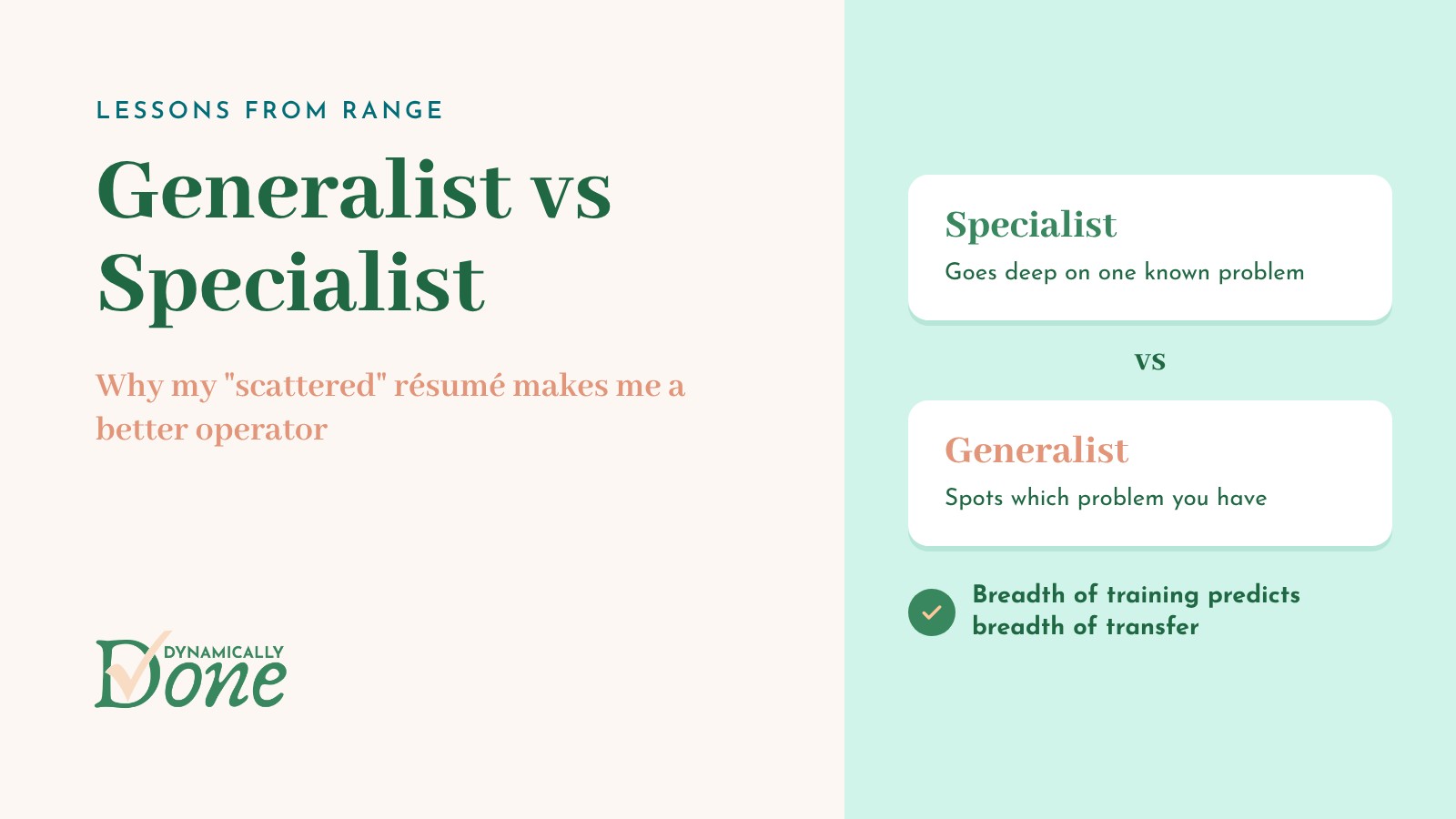
Generalist vs Specialist: Why My “Scattered” Résumé Makes Me a Better Operator
For a long time, “so what do you do?” was a hard question for me to answer in one sentence. In the generalist vs specialist debate, I was clearly the generalist, and I wasn’t sure that was a good thing.
I’ve gotten to do some cool things across 30+ businesses and 10+ industries. In high school, I was coordinating travel and communication for 115 cyclists racing the Tour of Missouri. I built smartphone apps for private country clubs. In Grand Forks, North Dakota, I helped grow a conference center and indoor football arena from 326 events a year to 471. That took two years. During the pandemic, I ran 260+ events with zero close contacts. I was the operations lead for the design and construction department of the Theodore Roosevelt Presidential Library. It’s the largest mass timber project in North Dakota. I’ve systematized a virtual event with 60,000+ attendees. Since 2011, I’ve been the right hand to the same hospitality founder. On paper, though, it can look more like a junk drawer than a career path.
Right now I’m reading Range by David Epstein. Near the end of Chapter 3 (“When Less of the Same Is More”), I hit this line:
“Breadth of training predicts breadth of transfer.”
It’s the best explanation I’ve found for why I’m good at business operations. It also made me look at that junk drawer completely differently. It turns out to be the most useful drawer in the house.
This post is for the small business owner who has worn every hat in the building. Maybe you quietly wonder if that makes you an expert in nothing. Stick with me here. On generalist vs specialist, I think your range might be the thing that makes you good at this.
What Does “Breadth of Training Predicts Breadth of Transfer” Mean?
It means the more settings you learn something in, the better you can use it somewhere new. Epstein calls it a classic research finding, and it isn’t specific to music. When you learn in lots of contexts, your brain builds general models instead of leaning on any one example. Those models travel with you.
He opens the chapter in 17th and 18th century Venice, with the figlie del coro, the “daughters of the choir.” They were girls raised at the Ospedale della Pietà, an orphanage that became one of Europe’s most famous music programs. Vivaldi wrote 140 concertos for them over six years. Instead of picking one instrument and drilling it, the figlie learned every instrument the place owned.
My favorite detail is about a violinist named Anna Maria. Over her lifetime, she took on the names of her instruments. She was Anna Maria del violino, del theorbo, del cembalo, del violoncello, del luta, della viola d’amore, and del mandolin. I laughed when I read that, because it’s my LinkedIn profile. Kaitlyn of the events, of the hiring, of the marketing, of the Asana.
Another one, Pelegrina, played oboe until her teeth fell out in her 60s. So she switched back to violin and kept performing into her 70s! When one way of doing the work disappeared, she already had another one in the drawer.
What Jazz Musicians Know About Running a Small Business
Jazz musicians improvise because nobody hands them the full score. Small business owners live in that same world every day. Epstein spends a big chunk of Chapter 3 on the contrast between jazz and classical training.
Django Reinhardt is the story that stuck with me. At 18, a candle in his wagon set off a fire that burned over half his body. It badly damaged two fingers on his fretting hand. He was bedridden for a year and a half. Then he taught himself to play with his thumb and the two fingers that still worked. He went on to help invent an entirely new style of jazz, without ever learning to read music.
What the Research Says
The research lines up with the stories. In one study of students at a selective music school, the ones rated exceptional didn’t start younger or practice more. They spread their effort across three instruments, while the average students stuck with their first one. Epstein also talks to Jack Cecchini, who played both jazz and classical guitar at a high level. He was almost completely self-taught. In his view, a jazz musician can pick up classical far more easily than a classical musician can learn jazz. Leon Fleisher, a master classical pianist, admitted his greatest wish was to improvise. He couldn’t do it at all.
For a small business owner, this is the part that clicked for me. A specialist is often brilliant at playing the score exactly as written. A small business doesn’t come with a score. Your best salesperson quits on a Tuesday, a client changes the scope, and the tool everyone relies on stops syncing. You have to play something anyway. Owners who have done a bit of everything are used to improvising. It just doesn’t feel like a skill from the inside. That’s the real generalist vs specialist gap.
Generalist vs Specialist: Which One Does a Small Business Need?
A small business usually needs a generalist running operations, plus specialists for specific, deep problems. The mistake I see most is hiring in the reverse order. Another is expecting one deep specialist to see across the whole company.
Here’s how I think about it:
| Specialist | Generalist operator | |
|---|---|---|
| Best at | Going deep on one known problem | Spotting which problem you have |
| Sees | One department in sharp detail | How the departments affect each other |
| Shines when | The problem is defined and stays in its lane | The problem is fuzzy or crosses departments |
| Wrong for you when | You don’t know yet what’s broken | You need one technical problem solved to an expert standard |
| Example | A paid ads specialist, an IT contractor, or an employment attorney | A fractional COO, an Integrator, or a seasoned ops manager |
My take: if you’re under 20 employees and you can’t name the real problem yet, start with breadth. You can always bring in depth once you know exactly where to dig.
What Running Events Taught Me About Running a Construction Program
The clearest proof of transfer in my own career? A hospitality grad ended up managing the program for the team designing and building the Theodore Roosevelt Presidential Library.
I came into that project as an event consultant. Using what I’d learned about the North Dakota events market in Grand Forks, I designed the event strategy. I also reviewed the architect’s plans for the event space. A couple of years later, I became the program manager and operations lead for the design and construction department.
I don’t have an architecture degree. What I did have was years of events work. In events, you live and die by a date that does not move. You need a long list of vendors to show up in the right order. Meanwhile, your client needs to feel calm while you’re juggling all of it.
I’d also spent three years in Grand Forks wishing our building had a different shape. With certain capabilities, we could have booked more events. So I knew exactly what to look for in those plans. A building project has a lot of the same bones. The materials and the budget were wildly different. The skeleton underneath was the same.
Hired for One Thing, Then Filling the Gaps
The same thing happened over and over before that. At the dog training business, I joined as the office manager and grew into the sales and business director. At Thin Metal Parts, I started in business development. I ended up owning hiring for the entire company for almost seven years. PeopleKeys, a freelance client, brought me on for light marketing. I ended up running the whole marketing operation. That included SEO, the CRM, the blogs, two ecommerce stores, and a website relaunch that’s still live over a decade later. Someone would hire me for one thing, I’d notice the gaps sitting right next to it, and I’d fill those too.
Every one of those industries sold something different (a service, a physical product, an assessment, an experience) to a different size of company. Each one handed me another tool for the drawer.
Why Small Business Problems Don’t Arrive Sorted by Department
Small business problems almost never show up labeled with the right department. Something that looks like a sales problem is often a marketing problem. And a marketing problem is often an operations problem wearing a disguise.
Think about how a problem lands on your desk. “We’re not closing enough deals” sounds like sales. The real cause could be leads that are a bad fit (marketing). It could be a proposal that takes too long to get out the door (operations). Or one person could be holding all the client knowledge in their head (team). A specialist will look in their own drawer first, because that’s what their training tells them to do. This is where generalist vs specialist stops being a theory.
That’s why my business audit, The Dynamic Deep Dive, looks across six pillars at once. They are Operations, Finance, Marketing, Sales, Technology, and Team. I built it that way because I’ve sat in enough of those seats to know the pillars lean on each other. Even I miss things when I only look at one at a time.
Maybe you’ve done every job in your company at some point. If so, you already have more of this than you give yourself credit for. Every one of those five hats counts as training.
Where Breadth Needs Structure
Range is great at spotting the pattern, and simple systems are what make the fix stick. Without them, range turns into being busy in a lot of different directions. Winning the generalist vs specialist argument doesn’t fix anything on its own.
Back to the junk drawer for a second. A drawer full of useful stuff only helps if you can find the tape measure when you need it. If you have to dump the whole thing on the counter every time, it’s costing you more than it saves.
In a business, the organizing looks like a few boring, lovely things. Documented processes for the stuff that repeats (this is even more critical now, in the world of AI). One place where work lives (for a lot of my clients, that’s Asana). A weekly meeting rhythm where the team names and assigns problems instead of re-discussing them. And one number everyone is watching.
For me, that number is profit. Revenue is nice to look at, but profit is the financial metric that matters most. It tells you whether all that range is turning into a business that gives you your time back. I would rather help someone make $100,000 in profit working 15 hours a week. That beats watching them chase $7 million in revenue while quietly losing $300,000 of it.
How to Build Range on Purpose
You don’t have to wait for a winding career to hand you range. You can build it on purpose, a little at a time.
- Borrow one practice from an unrelated industry every quarter. Ask how a restaurant handles a slammed Friday, how a hotel checks in 300 guests, or how a contractor schedules trades. Then ask what that would look like in your business. Some ideas will flop, and that’s fine. Burn those to the ground and try the next one.
- Hire and partner for range, along with depth. When you’re interviewing, ask about the job before the job and the side project they’re proud of. The person who ran a youth sports league on the side may be the best project manager in the room. (More on that in Your First Hire Isn’t Who You Think.)
- Treat side projects as training. The newsletter you started, the event you volunteered for, the year you freelanced from another country. That’s how you got a lot of the tools sitting in your drawer right now. Future you will thank current you for picking up a few more.
Who This Isn’t For
When it comes to generalist vs specialist, this isn’t an argument against specialists. Need a server migrated, a contract reviewed, or a paid ads account rebuilt? You want the deepest expert you can find. It’s also not permission to stay scattered forever. Range without structure is still a junk drawer you dump on the counter every week.
This is for the small business owner who has done a bit of everything and feels like the bottleneck. You want someone to look across the whole thing at once.
Generalist vs Specialist FAQ
Is it better to be a generalist or a specialist?
It depends on the problem. Specialists win on narrow, well-defined problems. Generalists win on fuzzy problems that cross departments, which is most of what a small business owner faces.
What does “jack of all trades, master of none” mean for business owners?
People usually mean it as an insult, but for an owner it describes the job. Wearing every hat builds the pattern recognition that helps you spot where a problem started.
What is Range by David Epstein about?
Range: Why Generalists Triumph in a Specialized World (Riverhead, 2019) argues that broad, varied experience often beats early, narrow specialization. That’s especially true in messy, unpredictable environments where the rules keep changing.
Do small businesses need a generalist COO or a specialist?
Most small businesses benefit from a generalist operator first. That’s someone who can see across operations, finance, marketing, sales, technology, and team. Specialists are most valuable once you know exactly which problem you’re solving.
How do I turn a scattered background into an advantage?
Pair it with structure. Name the patterns you keep noticing and write down the processes that repeat. Then keep your eye on profit so your range turns into results.
Your Junk Drawer Is an Asset
Here’s where I’ve landed on generalist vs specialist. A “scattered” background gives you a wider set of tools for problems that don’t look like anything you’ve seen before. From there, the work is organizing the drawer so you can find the right one fast.
My biggest tip: the next time a problem lands on your desk, pause before you decide which department owns it. Ask yourself where you’ve seen something like it before, even in a totally different industry. You’ll be surprised how often the answer is already in your drawer.
Want a second set of eyes on all six pillars of your business at once? That’s exactly what The Dynamic Deep Dive does. We’ll figure out what’s going on and what to fix first.
Free Ops Toolkit
The tools and freelancers I recommend to my clients
Every time a client asks me what I use for something, the answer goes on this list. It’s short enough to skim over coffee, so take what fits and skip the rest.